DBMS Course Summary
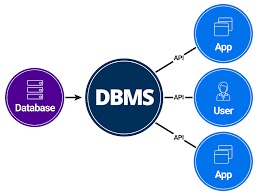
A Database Management System (DBMS) is software that stores, organizes, and manages data efficiently, allowing multiple users to access it securely.
Main Topics:
-
Introduction to DBMS
-
Manages data, users, and access.
-
Advantages: reduced redundancy, data consistency, security, backup, and recovery.
-
-
-
Hierarchical: Tree structure.
-
Network: Graph structure.
-
Relational: Tables (most common).
-
Object-Oriented: Stores data as objects.
-
-
Relational Model Concepts
-
Table (Relation) = rows (tuples) + columns (attributes).
-
Keys: Primary, Foreign, Candidate, Composite.
-
-
Relational Algebra & Calculus
-
Operations: SELECT, PROJECT, JOIN, UNION, etc.
-
Used to query and manipulate data.
-
-
SQL (Structured Query Language)
-
DDL: CREATE, ALTER, DROP.
-
DML: SELECT, INSERT, UPDATE, DELETE.
-
DCL: GRANT, REVOKE.
-
TCL: COMMIT, ROLLBACK.
-
Supports filtering, grouping, and joining tables.
-
-
Normalization
-
Process to remove redundancy and anomalies.
-
1NF → Atomic values
-
2NF → Remove partial dependency
-
3NF → Remove transitive dependency
-
BCNF → Every determinant is a key
-
-
Transactions & Concurrency
-
ACID Properties: Atomicity, Consistency, Isolation, Durability.
-
Prevent issues like lost updates and dirty reads.
-
Techniques: locking, timestamp ordering.
-
-
Backup, Recovery & Security
-
Protects data from loss or corruption.
-
Ensures authorized access and encryption.
-
-
Database Architecture
-
3 Levels: External (user view), Conceptual (logical design), Internal (physical storage).
-
-
Advanced Topics
-
Distributed Databases – Data across multiple locations.
-
NoSQL – Non-relational databases (e.g., MongoDB).
-
Data Warehousing & Mining – Storage and analysis of large datasets.
-
Big Data – Handling massive unstructured data.
-
- Teacher: Admin User